Kiewarra River
The DryThe Kiewarra River is both a physical landmark and a measure of change in Kiewarra: it carries memories of childhood, is connected to Ellie Deacon’s death, and becomes conspicuous in its absence when drought leaves its bed dry. Its changing presence joins personal loss to the material pressures of a town whose farms and livelihoods depend on water.
Setting and Physical Presence
The river borders property where Aaron Falk is staying, with a copse of gum trees marking the boundary. In summer, its sound would ordinarily be unmistakable: water moving through the country. That expectation gives the river more than a cartographic role. It is part of the landscape Falk knows, and its familiar noise supplies a standard against which the drought’s effects can be heard—or, eventually, cannot be heard.
The river also appears as a route through difficult country. A group of three hikers follows a track beside it, finding the walk slower than expected and the conditions hot and uncomfortable. When they discover a girl’s body, they bring her to the bank. The scene places a human death at the water’s edge, establishing an association that sharply contrasts with the river’s earlier role as a place of recreation.
Drought and the Changed River
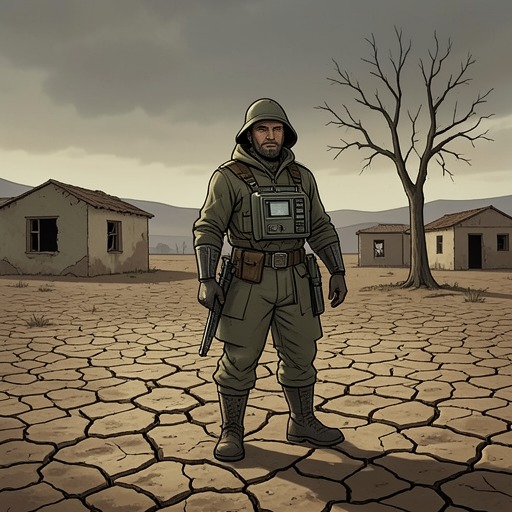
The drought has made water scarcity part of everyday rural life. With no rain, there is no feed for livestock; farmers face difficult decisions and level rifles at animals weakened by the conditions. Flies gather around the vulnerable livestock, while the town endures successive days of intense summer heat. The river is implicated in this wider crisis not through a separate policy or dispute, but as a waterway whose absence can be measured against what the landscape and its residents expect from it.
Falk recognizes that absence while walking across the fields. The property reaches the river, and the low summer sun accompanies his return toward it. He expects to hear rushing water, the sound of the river cutting through the country. Instead, he hears nothing. His realization develops from unease into certainty: the riverbed is dry, and he runs toward the river. The moment turns a general awareness of drought into a direct encounter with its scale. The missing sound is evidence, not merely atmosphere.
Memory, Recreation, and Loss
The river’s silence calls up the water that had once drawn Falk and Luke Hadler into summer play. Falk remembers the two of them diving, splashing, and cooling themselves there. The same river also belongs to quieter memories: fishing on bright afternoons with his father beside him. These recollections give the river a personal history, linking childhood friendship and family life to a landscape that has since altered.
That remembered water carries a darker association as well. Falk’s thoughts turn to Ellie Deacon, whose drowning involved the river entering her body. The juxtaposition is stark: water that had offered recreation and formed part of familiar routines also became the setting of her death. The river does not explain that death, but its place in Falk’s memories brings ordinary childhood scenes into contact with grief and the unresolved past.
The River in Kiewarra’s Wider Circumstances
The drought shapes the town beyond the river itself. At the church after the deaths of Luke Hadler, Karen Hadler, and Billy Hadler, one local man connects the suffering of farmers to the extreme weather and proposed changes to government subsidies. His complaint makes clear that environmental hardship is also experienced as economic and political pressure: the lack of rain and feed leaves farming families exposed, while decisions about support become a source of anger.
Other pressures in Kiewarra arise through the town’s social and financial relationships. Gerry Hadler explains that people were reluctant to oppose Mal Deacon because they depended on one another for business and ordinary social life, while Deacon’s favors could make dissent costly. Separately, Scott Whitlam diverts money from an educational grant after creditors threaten his family and he seeks time to repay what he owes. These circumstances are not presented as consequences of the river’s dryness. Rather, they show the human systems surrounding the drought-stricken landscape: scarcity, dependency, debt, and fear can all shape what residents face and what they choose to conceal.
Narrative Significance
The Kiewarra River links distinct times and kinds of evidence. Its remembered flow belongs to Falk’s childhood; the bank is associated with the discovery of a dead girl; and its present dryness reveals how far the environment has changed. The novel makes that change legible through sound: what should be heard is missing, and Falk’s recognition converts an initially vague foreboding into a concrete discovery.
In this way, the river is not simply a scenic backdrop. Its condition gives the drought a local, perceptible form, while its history gathers friendship, family memory, and death into one place. The contrast between the water Falk remembers and the silent riverbed he encounters makes environmental loss inseparable from the town’s human past, without suggesting that the river itself resolves the mysteries or conflicts attached to it.